

AZAFRÁN
How to take saffron | Beejoy
Taking saffron can be a simple way to incorporate this botanical ingredient into your wellness routine.
But if you’re considering using it as a supplement, it’s natural to have some questions: Is it better to take it in the morning or at night? Should it be taken with food? Do you have to take it every day?
The answer depends mainly on the format, the product instructions, and your habits. More important than finding the perfect time is choosing a suitable way to consume it and maintaining a consistent routine.
What is the best way to take saffron?
Saffron can be consumed as a culinary spice, in infusions, or through supplements containing extracts ofCrocus sativus. When used as a supplement, it is advisable to follow the manufacturer’s instructions, as the amount and concentration of the extract may vary between products.
Clinical studies have examined certain saffron extract formulations at doses of approximately 28–100 mg daily. However, this does not mean that this amount is appropriate for everyone or equivalent to consuming a few strands of saffron. Therefore, before incorporating it into your routine, it is advisable to check the amount indicated per serving and respect the instructions for use.
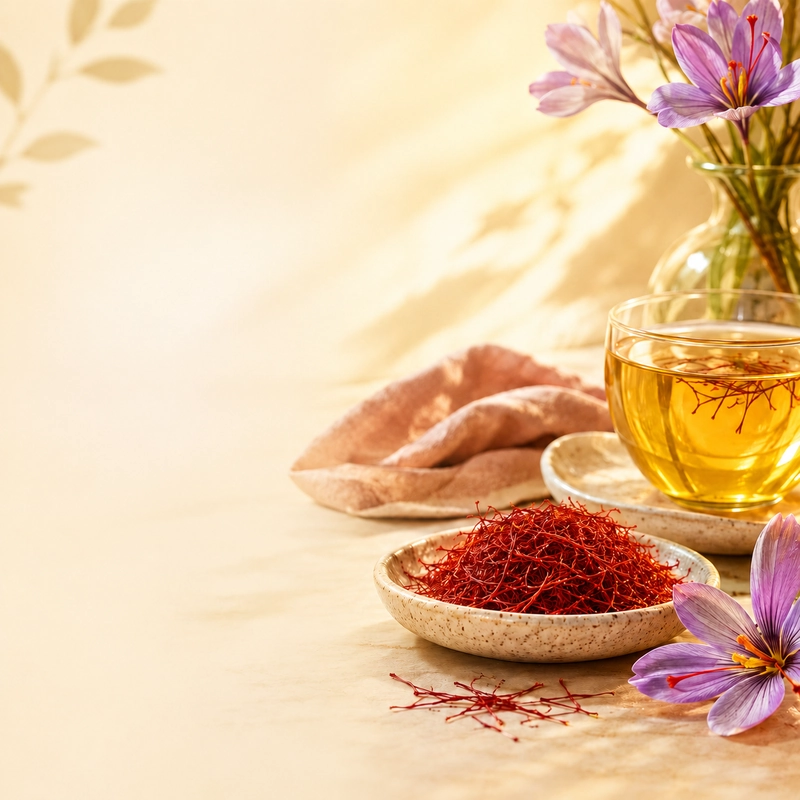

When should you take saffron: in the morning or at night?
There is not enough evidence to say that saffron works best at a specific time of day. Some people prefer to take it in the morning, along with breakfast, because it’s easier for them to remember. Others incorporate it into their afternoon or evening routine.
Clinical studies have used different administration times, including doses split between morning and night.
The important thing is to follow the frequency indicated for the product and choose a schedule you can maintain. If you use a formula that combines saffron with other ingredients, you should also consider its specific instructions.
Is it better to take saffron on an empty stomach or with food?
Saffron has been used in studies both with and without food. It is not strictly necessary to take it after a meal, but it is worth considering the following guidelines:
Take with food or a snack if you have a sensitive stomach.
Make adjustments if you experience nausea, heartburn, or a feeling of heaviness.
Always follow the label on your supplement
How often should saffron be taken?
Daily use in research
Many studies on saffron extracts have involved daily administration over several consecutive weeks.
Evaluation windows
Various studies have evaluated periods ranging from four to eight weeks, while others have conducted longer-term follow-ups. These timeframes correspond to scientific protocols and do not guarantee individual results.
Record of the excess
If you decide to incorporate a saffron supplement into your routine, daily consistency is the key factor in correctly following the formula’s instructions.
Avoid increasing the dose
Not seeing immediate changes does not justify increasing the portion size. Taking more than the recommended amount does not speed up results and may increase the risk of adverse effects.

How to incorporate saffron into your daily routine
A wellness routine doesn’t need to be complicated. The ideal approach is to find a time that fits naturally into your daily habits:
Check the label
Check the amount of extract per serving, the suggested frequency, and the manufacturer’s consumption instructions.
Choose a regular time
Breakfast or any regular meal can serve as an automatic reminder that facilitates consistency.
Maintain the indicated amount
Avoid increasing your intake in an attempt to speed up results; when it comes to supplementation, consistency beats excess.
Observe your tolerance
Pay attention to how your body responds and to any digestive discomfort or sensitivity that might arise.
Review your routine if necessary
If you take medications or combine several supplements at the same time, consult your healthcare professional before continuing to use them together.
Frequently Asked Questions About How to Take Saffron
Various clinical studies have evaluated daily saffron extract intake over several consecutive weeks. For personal use, it is essential to follow the recommended serving size and duration stated on the product label, and consult a healthcare professional if you have questions regarding continuous consumption.
There is no single amount applicable to all formulations. Several studies have utilized standardized extracts providing approximately 28–30 mg daily; however, this scientific benchmark is not a universal recommendation and cannot be translated directly into culinary threads.
It depends on the specific product and your wellness objectives. Multiple clinical trials have assessed daily use over periods ranging from four to twelve weeks. These study intervals do not establish a mandatory duration for everyone.
It depends on the active ingredients, dosages, and your personal health profile. Before combining multiple dietary supplements—especially if you are currently taking prescription medication—it is recommended to seek professional medical advice.
Refer to the instructions on your product’s packaging. As a standard safety guideline, do not double your next serving to compensate for a missed dose.